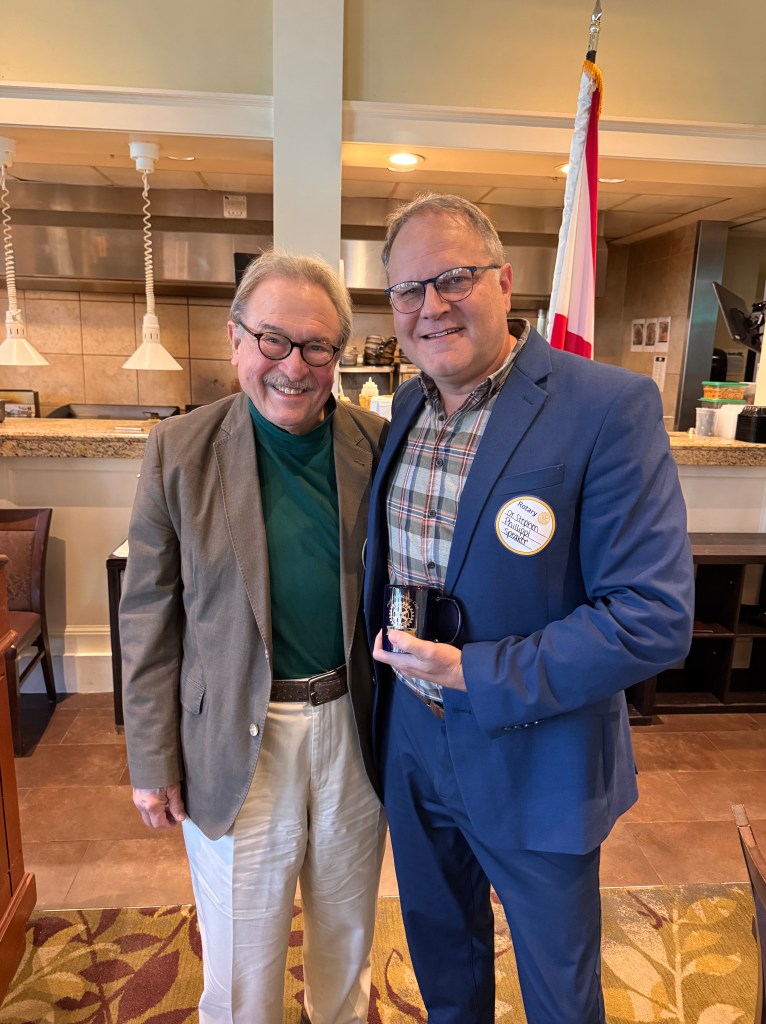
Guest Speaker: Dr. Stephen Phillippi, LSU School of Public Health
Hosted by Prentiss Smith
It’s not every Thursday morning that our club gets a dose of humor, humility, and hard-hitting insight all in one talk… but Dr. Stephen Phillippi managed to deliver just that.
Dr. Phillippi, Director of the Center for Evidence to Practice at Louisiana State University, joined us to shed light on one of the most pressing issues in our country today—mental health care. He opened with a laugh, joking that LSU might have to “work for food now” after giving away $50 million, and that his “conflicts of interest” included a meal owed to him by fellow Rotarian Prentiss. But beneath the humor was a powerful message about the urgent need for accessible, effective, and compassionate mental health services.
The Reality: 1 in 5 Americans Struggle
Dr. Phillippi reminded us that one in five Americans faces a mental health condition, and that number didn’t improve after COVID—it worsened. Access to care remains a national challenge, particularly when people can’t get help quickly or when the services they reach aren’t up to quality standards.
As he put it:
“Access to poor care is still poor care.”
The LSU Approach: Turning Research Into Real-World Solutions
At LSU’s Center for Evidence to Practice, Dr. Phillippi’s team focuses on training the workforce after graduation—helping clinicians and agencies apply proven, evidence-based methods in the real world. They don’t just train and walk away; they partner with providers to ensure lasting quality and sustainability.
Their work includes:
- Training over 4,000 clinicians in effective, research-backed methods for trauma, parenting, and substance abuse recovery.
- Creating interactive referral tools so schools, hospitals, and community leaders can connect families to the right services the first time.
- Supporting the growing 988 Crisis Response system—ensuring that anyone in crisis has someone to talk to, someone to respond, and a safe place to go.
Why This Matters: A Look at the Numbers
Dr. Phillippi didn’t shy away from tough statistics:
- Suicide is the second leading cause of death among young people in Alabama.
- Firearms are involved in most of these deaths—highlighting the life-saving importance of secure storage.
- Substance abuse deaths are beginning to decline, thanks in part to Narcan and better emergency responses.
- Among veterans and law enforcement, suicide rates remain deeply concerning. Language and connection—simply reaching out—can be powerful prevention tools.
He also noted that grief and loss are now the top reasons teenagers drop out of school. “If we just stopped and asked, ‘Who have you lost?’ before a student leaves school, we might save more futures than we realize,” he shared.
A New Model of Crisis Care
Dr. Phillippi explained the growing national movement toward voluntary, community-based crisis care—one that lessens the burden on police and emergency rooms. The approach follows brain science and emphasizes three simple steps:
Calm → Connect → Collaborate
Rather than forcing people into treatment, crisis teams focus on meeting immediate needs—food, shelter, safety—and building trust before guiding them toward care. It’s an approach rooted in dignity, compassion, and understanding that healing starts with connection.
The Rotary Takeaway
For Rotarians, the message was clear: mental health is everyone’s business. We can all play a part—by learning the signs, encouraging open conversations, and sharing life-saving resources like 988.
Dr. Phillippi’s closing reminder captured the heart of his talk:
“Isolation kills—connection saves.”
It’s a statement that resonates deeply with Rotary’s mission of Service Above Self. Sometimes, the most powerful act of service is simply showing up, listening, and helping someone know they’re not alone.
What You Can Do
- Know the number: Call or text 988 for immediate help in a mental health crisis.
- Secure firearms safely: Reducing access saves lives.
- Check in on others: A simple conversation can make a difference.
- Support your local mental health organizations.
Final Thought
Dr. Phillippi reminded us that behind every statistic is a person, a family, and a story. The work being done at LSU is proof that with education, compassion, and collaboration, communities can make mental health care more accessible, timely, and effective.
Let’s continue doing our part—one conversation, one connection, and one act of kindness at a time.


Leave a comment